A Deep-Dive Into IFP-Components →
Read here

Lightweight manufacturing is under pressure. Demand for lightweight materials is accelerating across aerospace, automotive, robotics, drones, professional tools and many other industrial markets, driven by efficiency targets and regulatory mandates (Hexcel 2023). Composites, such as carbon and aramid fiber, can generate outsized product value, yet the majority of parts are still produced with significant manual labor, creating a fundamental mismatch between what the market demands and what the industry can efficiently deliver (JEC Observer 2022).
For European manufacturers, this pressure is compounded by fierce competition from regions where labor-intensive composite work is significantly cheaper. In an industry where manual labor dominates production costs, this cost differential is difficult to overcome through automation improvements alone.
The path forward requires more than automation. It requires autonomous manufacturing systems that can perceive, decide, and adapt in real time. Manufacturers worldwide are already investing heavily in AI-enabled production systems (Deloitte Smart Manufacturing Survey 2024). US-based pioneer Hadrian, raised $260M in a Series C for their mission to make precision metal manufacturing autonomous. In this context, the distinction between automation and autonomy will determine which manufacturers lead and which struggle to compete.
This is why Holy Technologies is pioneering autonomous composite manufacturing: to drive the innovation and competitiveness the industry needs, particularly for European manufacturers facing unique competitive pressures.
Despite accelerating demand for lightweight materials and growing global investment in AI-enabled manufacturing, composite production remains dominated by manual prepreg layup, highly specialized technicians, long development cycles, and production waste rates of 30-40% for standard prepreg workflows (ORNL 2017). Manual prepreg layup uses resin-pre-impregnated carbon or aramid fiber fabrics, which are placed by hand into molds to build composite parts.
This creates three systemic barriers:
%20(1).jpeg)
These constraints do not only slow production, they hold back innovation and competitiveness. Slow iteration cycles and high development costs make it harder for engineering teams to introduce new designs or explore lightweighting strategies. For European manufacturers, the challenge is compounded by growing competition from overseas regions where labor-intensive composite production is significantly cheaper.
This is why automation and autonomy are so relevant for composites: the baseline is inefficient, variable, and slow. Any improvement compounds quickly across design, production, and lifecycle. But not all improvements have an equal impact.
Automation refers to production systems that follow programmed instructions with minimal human intervention. These systems replace manual variability with precision, reduce cycle times, and enable throughput that manual processes cannot match. They excel at repeatability, speed, and executing tasks from start to finish. Companies like Tesla and Apple have built empires on highly automated assembly lines that deliver consistent quality at scale.
In the composites industry, several automated production systems are now available:
These systems represent a significant step forward from manual production. They reduce manual labor and increase efficiency, delivering repeatable production at speeds no human technician can achieve. For low-volume, high-value applications (such as large aerospace parts), they have proven their value.
But they come with important constraints. Because ATL and AFP rely on pre-impregnated (prepreg) tapes and tows that must be cut to length, they generate significant scrap and waste material. Additionally, cut prepreg cannot be reused in high-performance applications because the cut fibers cannot be restored to their original state. Instead, they are typically chopped into small pieces to create a homogeneous material, resulting in significantly reduced mechanical performance. This increases dependency on expensive raw materials and limits cost-efficient scaling. Material costs become a primary cost driver at higher volumes, making these automated approaches economically viable only for low-volume aerospace programs while leaving most composite applications without an affordable, competitive path to scale.
Beyond material efficiency and recyclability, automation faces structural limits. Automated machines follow predefined instructions but cannot sense, decide, or adapt independently. When conditions change – whether a material deviation, a process shift, or unexpected machine behavior – automated systems require human intervention to diagnose problems, adjust parameters, and restore production flow.
This is where the difference between automation and autonomy becomes critical. Automation improves efficiency of execution. Autonomy adds intelligence of operation. And in a manufacturing landscape increasingly shaped by AI and adaptive systems, this distinction will determine competitive advantage for industries seeking high-volume, cost-competitive composite components.
Autonomy gives manufacturing systems three fundamental capabilities that automation alone cannot provide:
Where an automated line executes a plan, an autonomous line evaluates what should happen next, optimizes across constraints, and continues running even under changing conditions. Autonomy transforms rigid production lines into responsive, self-optimizing factories, leading to higher throughput and lower dependency on human labor – all of which translate directly into stronger innovation capacity and lower unit costs.
It is important to note that autonomous manufacturing does not mean "AI everywhere". The foundation remains rule-based. AI adds intelligence on top of this reliable operational infrastructure.
Autonomy is particularly valuable in composite manufacturing because the nature of the material requires many sequential, tightly linked production steps that influence each other. Small variations in fiber orientation, resin distribution, or cure temperature can significantly change the performance and quality of a part. An autonomous system can detect these variations early and adjust parameters in real time, increasing repeatable outcomes efficiently without constant manual intervention.
But in today’s composite manufacturing industry, autonomy cannot simply be layered on top of existing automation. Automated technologies still face structural constraints that prevent cost-efficient scaling. To make composites truly scalable and competitive for high-volume applications, the industry needs a new manufacturing system: one that removes these constraints through better automation across the entire process chain, and then adds autonomy to coordinate and adapt that workflow. At Holy Technologies, we are building that.
Holy Technologies is developing a new manufacturing system that replaces manual prepreg-based workflows, overcomes the limitations of existing automated technologies, and is designed for autonomy from day one. For that we have built:
1. A New Automated Production System: Infinite Fiber Placement (IFP)
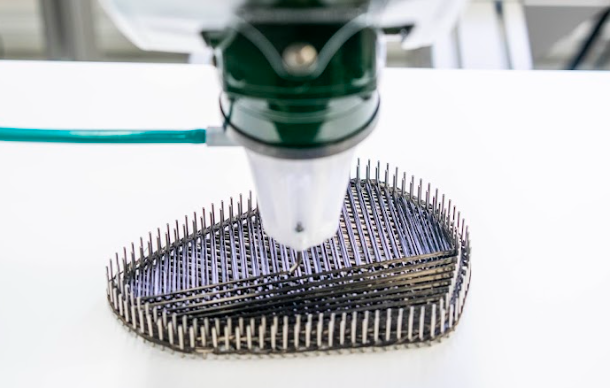
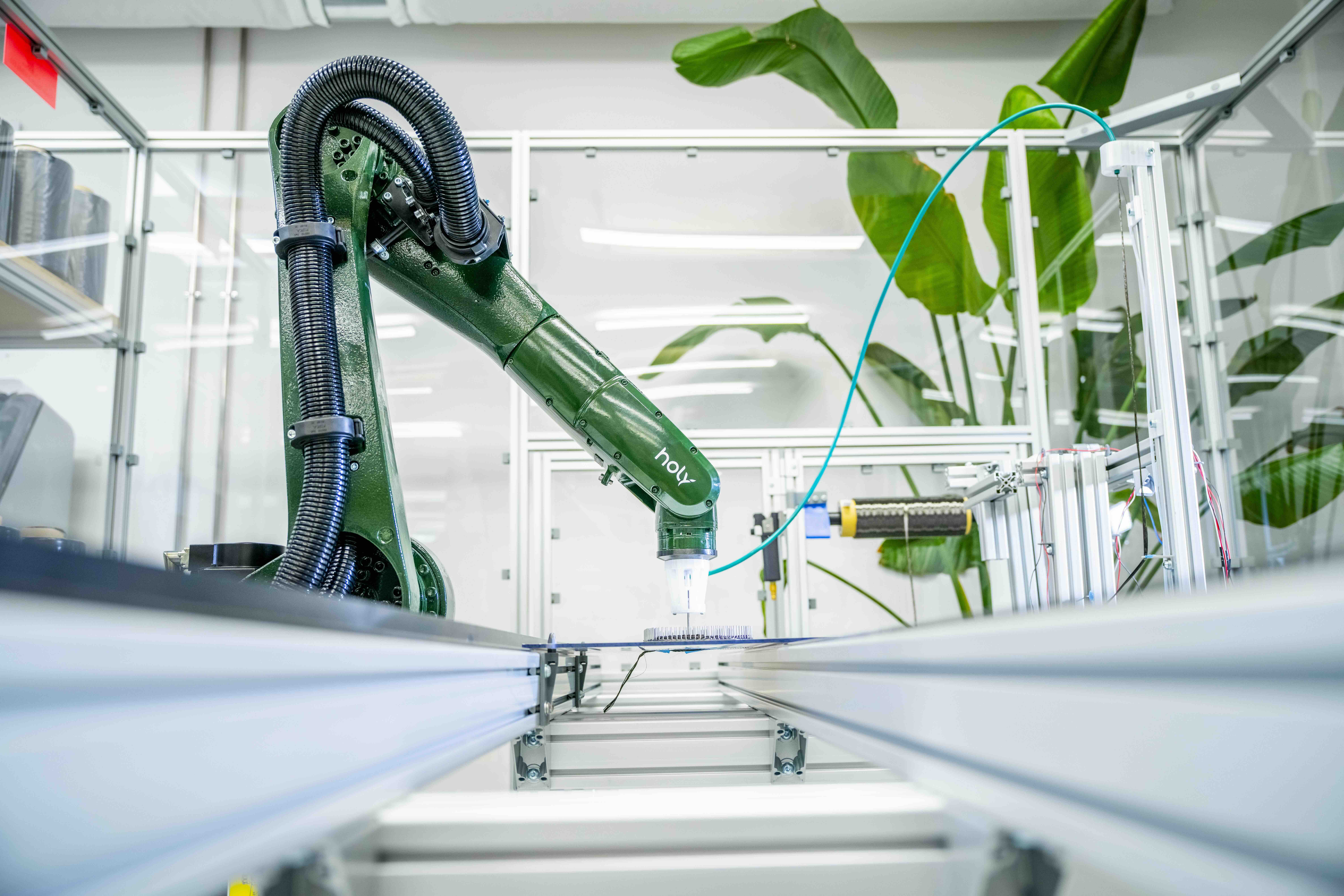
IFP is a patented technology that replaces manual prepreg-based processes with a robotic system that lays continuous fibers (such as carbon or aramid) along pre-calculated paths to enable complex geometries and tailored mechanical performance. This removes cutting, placing, and orienting (these steps are the slowest and prone to errors in manual composite production).
By using continuous fiber instead of cut prepreg tapes, IFP achieves:
IFP is the first step to make composite production efficient, fast, and repeatable and creates a baseline for cost-efficient, scalable composite manufacturing.
2. A Digital System Designed for Autonomy: Holy OS
To maintain throughput, maximize efficiency, and continuously improve production even when conditions change, the system needs intelligence. This means unified data, coordinated workflows, and software-defined control across the entire production process, which is why Holy Technologies is developing Holy OS from day one.
Holy OS vertically connects the entire workflow – digital design, fiber placement, resin injection, curing, quality assurance, and closed-loop recycling – into one digital system. It collects data across every production step, because without data, there is nothing to perceive, decide, or adapt to. This data infrastructure creates the foundation for autonomous capabilities. The operating system creates a software-driven production workflow that learns from each part it builds and is designed to evolve into full autonomy over the next few years, where the system can sense conditions, make decisions, and adapt parameters in real time without human intervention.
At Holy Technologies, autonomy does not remove people from the process. It empowers them with better tools to extend the system's capabilities. Humans remain central for innovation, validation, and operations that are inefficient to automate. Human insight and machine intelligence operate side‑by‑side, each reinforcing the other.
Automation and autonomy are relevant for the global composite industry. But several structural pressures make autonomy more than an efficiency upgrade for European manufacturers:
Autonomy addresses the underlying constraints: speed, adaptability, and local competitiveness. It enables European manufacturers to compete on efficiency and rapid innovation. This is why Europe must accelerate investment into autonomous production systems. Not just to keep pace with global trends, but to establish competitive advantage in the industries that matter most for its economic future.
For decades, the composite industry has been limited by manual workflows, high costs, and low scalability. Automation has improved parts of the process, delivering enhanced efficiency and repeatability where it has been implemented. But automation alone cannot overcome the fundamental barriers that keep composites expensive and slow to scale.
Autonomy will. Not by replacing automation, but by building on it. Adding perception, decision-making, and adaptive control that transform production from rigid execution into intelligent operation.
Holy Technologies' approach combines a breakthrough automation technology (IFP) with a software-defined production system to create the foundation for autonomous, and highly competitive, composite manufacturing. We are reimagining what composite manufacturing can be when intelligence, efficiency, and adaptability are designed into the system.
The path forward is clear: Automation + Autonomy = Competitiveness.
Automation delivers efficiency through speed and repeatability. Autonomy enhances efficiency by adding intelligence through real-time perception and adaptive control. Together, they create the competitive advantage Europe's lightweighting industry needs.
Holy Technologies is delivering this, to enable radically better components for our customers. In an era where AI and intelligent manufacturing define industrial competitiveness, the question is: who will lead that transformation, and how quickly can they move? At Holy Technologies, we are building the answer.
Get in touch to learn more about our technology or to book a free component assessment with us.
.svg)
.png)