A Deep-Dive Into IFP-Components →
Read here


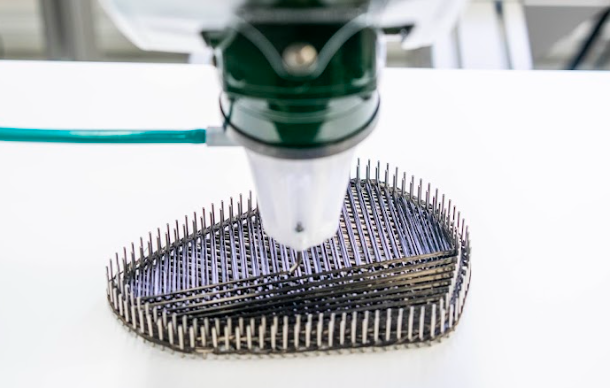
IFP stands for "Infinite Fiber Placement" and is our proprietary robotic production technology that builds components by placing continuous dry fibers (such as carbon or aramid) along digitally optimized load paths.This software-defined approach means we can tailor each component's mechanical properties to exact specifications. See the image below to understand how it works.
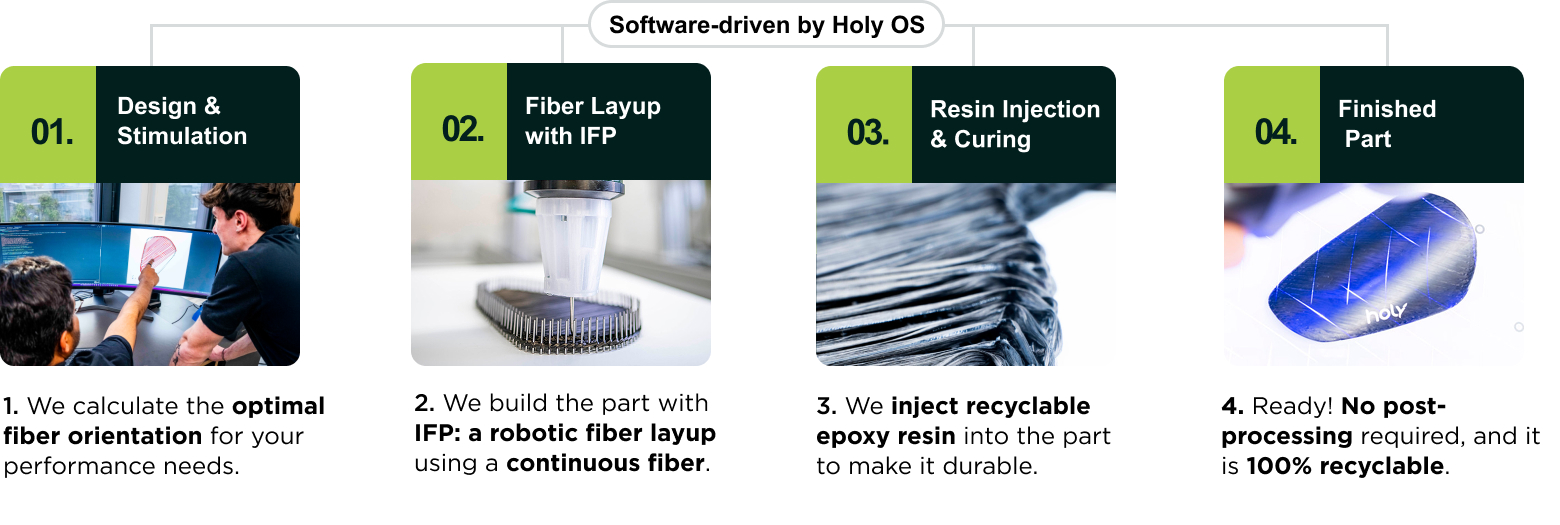
IFP is optimized for specific types of load-bearing components. Here is what we manufacture:
1. Load-Bearing Components
IFP-components are designed to carry significant mechanical loads, such as structural parts, industrial hand-held tools, or medical wearables. These are parts that experience tension, compression, bending, or combined loading. We optimize the fiber orientation to reinforce parts as needed.
2. Flat or Single-Curved Surfaces
We manufacture parts that are either flat or have a single-curvature surface (curved in one direction only). This includes panels, brackets, frames, ribs, and similar structural elements.

3. Small to Medium-Sized Parts
Component sizes range from a minimum of 100mm x 100mm up to a maximum of 800mm x 800mm (3,9 x 3,9 in up to ~31 x 31 in). This size range covers many industrial applications, from robotic to seat structures.
4. Carbon and Aramid Fiber Parts
Our default material is dry carbon roving (Tenax IMS65), but we also work with aramid fibers. Glass, natural, and hybrid fibers are available on request.
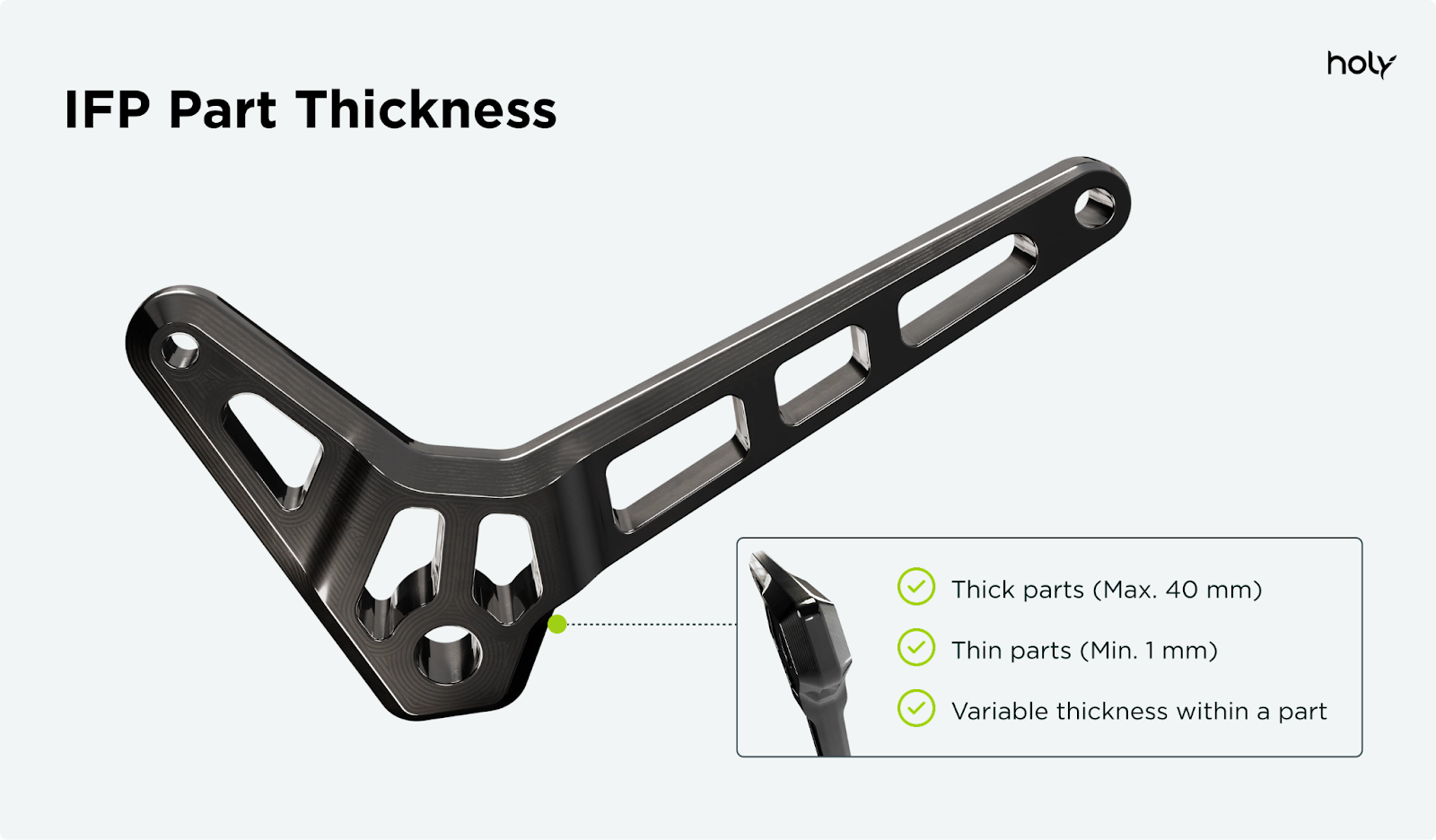
5. Thin and Thick Parts
Unlike most composite technologies that focus on either thin or thick parts, IFP handles both, with wall thicknesses from 1 mm to 40 mm (~0.04 x 5.9 in). We can also produce components with varying thicknesses in the same part – something that is difficult with prepreg-based processes.
While we work with a wide range of industries, IFP-components are well-suited for:
If your industry is not listed here, that is not a problem. We focus on load-bearing components for mid- to high-volume production. If you have a component that meets the criteria discussed in this section, we can likely help.
One critical point to understand: IFP is optimized for scalable production volumes, not single prototypes or highly specialized low-volume applications. We start at 50 components/year and scale from there up to 200,000+ parts annually. This focus on volume manufacturing means:
Find the full component specifications here.
IFP delivers three core advantages at the component level and two at the process level.
1. Load-Bearing Performance At Reduced Weight
IFP-components allow metal-to-composite transitions achieving up to 70% weight gains and are up to 30% lighter than prepreg alternatives, while maintaining or enhancing the structural performance a part needs.

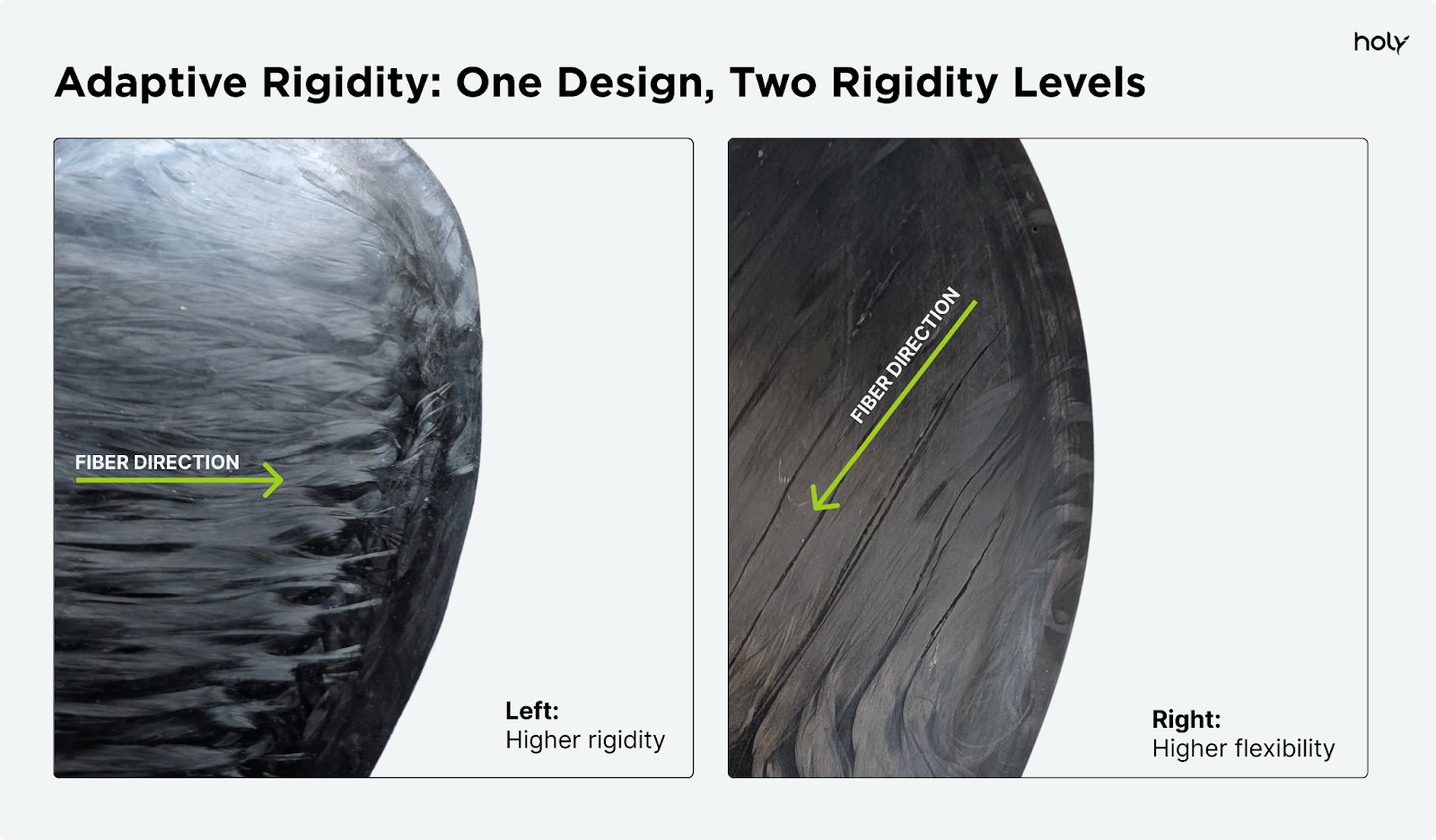
IFP-components show visible optimized fiber paths, a distinctive surface finish and visual proof of the engineered performance built into every part.
2. ESG-Ready: 100% Recyclable And Zero Scrap
3. Advanced Design Features Allow Maximum Design Freedom
Unlike traditional composites that require extensive post-processing, IFP-components integrate advanced features directly during manufacturing, eliminating secondary operations and preserving fiber integrity, and most importantly: maximize your design freedom.
Features we can integrate during manufacturing include:
1. Rapid Development: 12 Weeks from CAD to Production-Ready Prototype
We deliver functional prototypes within 12 weeks that come with a scalable manufacturing concept. This means you can transition directly to serial production without redesign or retooling delays, reducing time-to-market.
2. Scalable & Flexible: From 50 to 200,000+ Parts
Start small and scale as you grow – no heavy retooling, no supplier switching, no massive capital investment required. Our process adapts to your volume needs, starting with 50 units annually, ramping to 200,000+. This flexibility means:
Read more about our services here.
IFP-components are designed for manufacturers who need load-bearing lightweight parts at scale. Use this checklist to evaluate if IFP fits your requirements. If you checked all component requirements and at least one of the needs below, IFP is likely a strong fit for your application. We offer free part assessments to evaluate your specific requirements.
.jpg)
Not certain yet? Read our honest technology comparison article, which helps you understand which technology is a fit for which type of part.
Describe your requirements. Our team will assess your business and technical needs and deliver a proposal that keeps you competitive.
.svg)

.jpeg)
.jpeg)