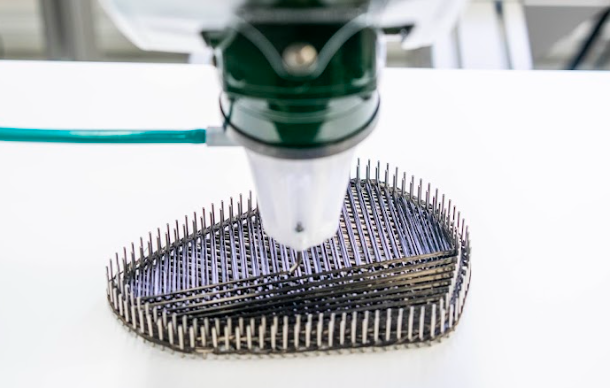
A Deep-Dive Into IFP-Components →
Read here

Holy Technologies Year in Review
The year 2025 was when we moved from proving our technology works on single units to proving it works in serial manufacturing. We transitioned from prototyping to serial production, from a small team to a manufacturing operation, and from early customer conversations to active relationships across three industries. Every milestone this year reinforces our mission: to make lightweight manufacturing autonomous.
The composite industry has been stuck in manual workflows for decades. High costs, slow development cycles, and limited scalability have kept lightweight materials out of reach for most manufacturers. This creates a competitiveness problem.
Automated systems improve efficiency and speed, but remain expensive and material inefficient, and are viable for low-volume, high-value applications only.
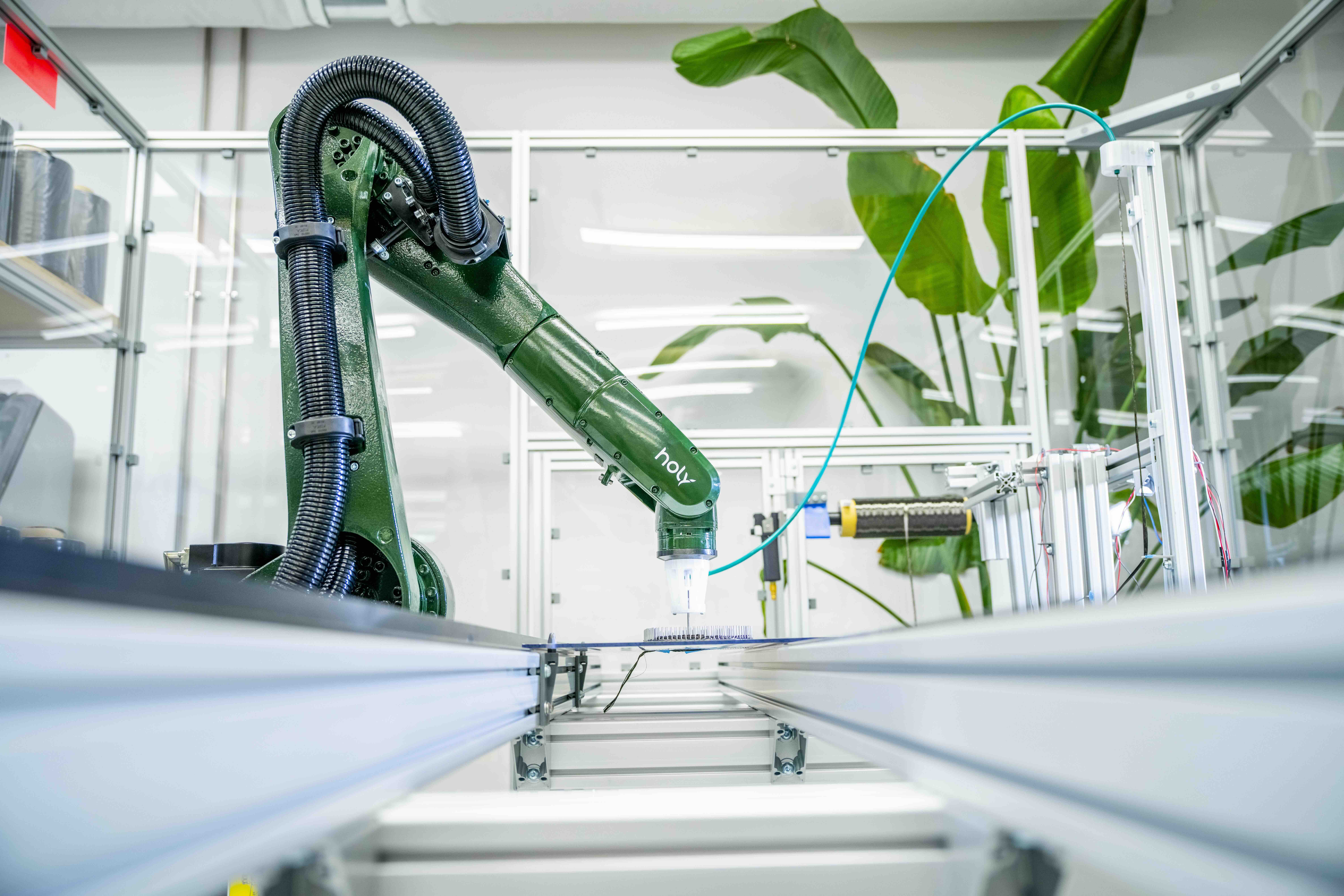
Holy Technologies sees autonomy as the answer to make composite manufacturing competitive for mid-and high-volume applications as well. By rethinking automation and adding an intelligence layer to the production process that can perceive conditions, decide, and adapt to changes, we create self-optimizing systems that deliver higher throughput, repeatable quality, and lower costs, paving the way to scalable, cost-efficient composite manufacturing.
Read our full blog post on our autonomous manufacturing vision here.
Our customers are pushing the boundaries of what is possible with lightweight components. From Formula 1TM teams demanding performance and recyclability to industrial manufacturers needing cost-effective scaling, we are working with innovators who understand that composites are essential for innovation and lightweighting, and the competitiveness of their products.
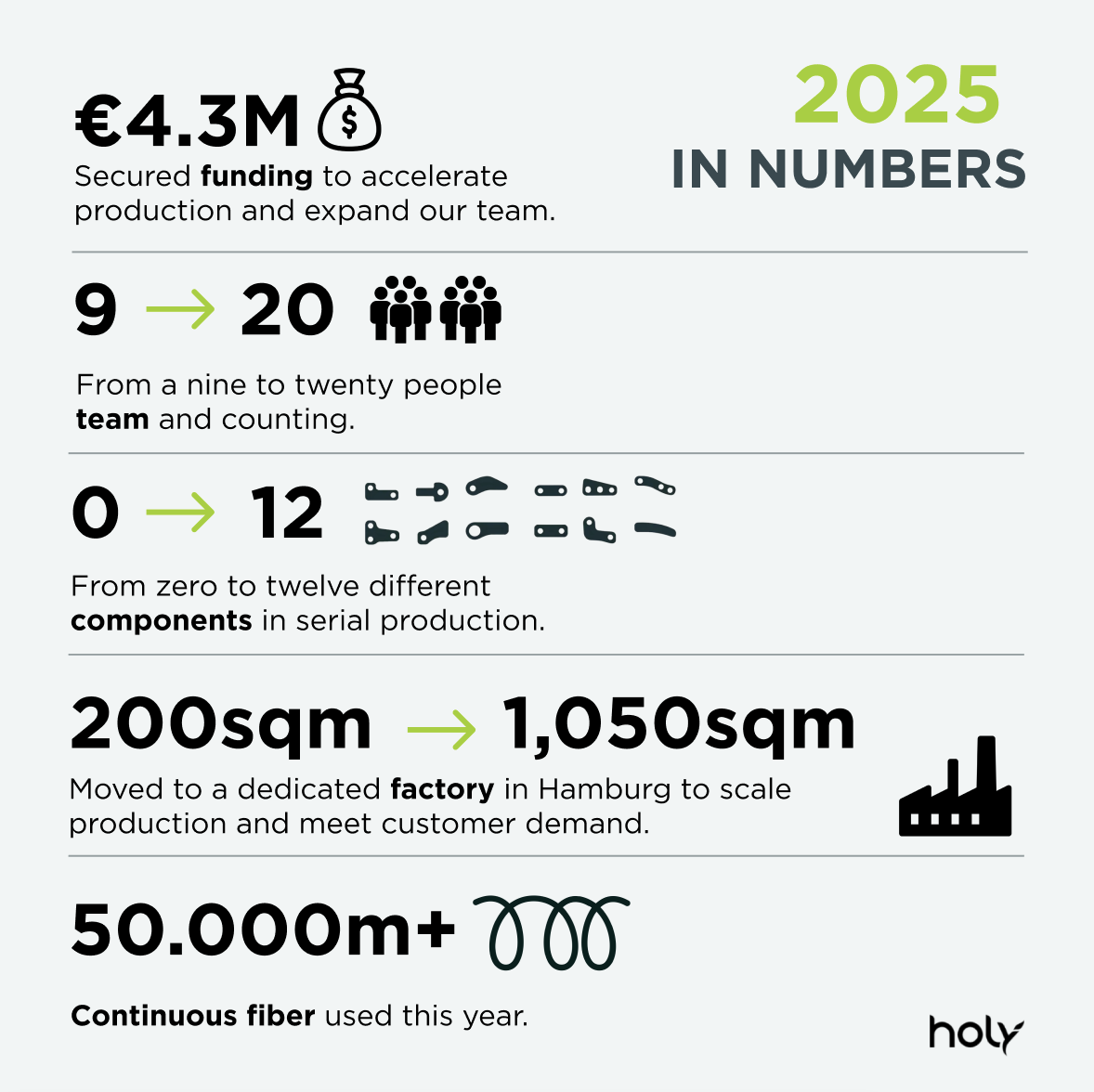
This year, we moved from 0 to 12 twelve different customer components in serial production, spanning prototype development and its transition to serial production. These customer relationships prove that IFP technology works not just in theory, but in practice: delivering radically better lightweight components that help our customers innovate faster and compete more effectively.
“As 2025 comes to a close, I am genuinely grateful for the trust some of the most innovative enterprises place in us to help them win in their markets. None of this would be possible without an exceptional team, and I am proud of the people I get to work with every day – who bring an incredible amount of grit, dedication, and heart to everything we do. In 2026, we will double down and significantly scale our services to support our customers at much larger volumes.” Bosse Rothe Frossard, CEO & Co-Founder
2025 was about proving IFP works and drives value for our customers. 2026 is about scaling intelligently.
We will continue expanding production capacity, keep on industrializing our operation, and partnering with manufacturers who need lightweight components that stand out in their market – fast and at scale. The path to autonomous manufacturing is clear. The question is not whether autonomy will define the future of composites, it is who will lead that transformation.
At Holy Technologies, we are building that future. Thank you to our team, our customers, our investors, and our partners for making 2025 possible. We are just getting started.
Book a meeting with us to evaluate your part, discuss an upcoming project, or learn more about our services.
.svg)

.png)