A Deep-Dive Into IFP-Components →
Hier lesen


In a world constrained by energy, cost, emissions, and rising competitive pressure, lightweighting is becoming a decisive driver of industrial competitiveness. Global demand for lightweight components is accelerating rapidly (Hexcel, 2023). The most capable materials, composites, however, are still largely manufactured into components by hand. While automation is on the rise, existing technologies are very expensive, remaining economically viable only for low-volume, high-value (aerospace) applications. For cost-efficient production manufacturers rely on offshore production models where labor is cheaper, creating long lead times and supply chain vulnerabilities.
The gap between what manufacturers demand and what the industry can efficiently deliver is widening, threatening the industry's competitiveness. To restore competitiveness, manufacturers need faster time-to-market through rapid development and production cycles. They need components that deliver performance and differentiation. They need resilient, cost-efficient production that remains feasible even at higher volumes.
A disruption in production would create an entirely new market where metal parts are replaced by lighter, structurally superior composites, marking a fundamental step change in manufacturing.
Despite heavy investments in automation, composite manufacturing still cannot meet these demands. Why? The missing piece is software intelligence to reduce dependency on manual labor and increase efficiency across operations. Holy Technologies is solving this by building an autonomous manufacturing system that makes composite production competitive on speed, cost, and scale. The key to achieving this is Holy OS: the factory operating system for autonomous composite manufacturing.
The broader manufacturing industry is moving rapidly toward software-defined production. Deloitte reports that 78% of manufacturers allocate more than 20% of budgets to smart manufacturing initiatives (Deloitte, 2025). Industries are adopting Industry 4.0 principles, progressing from basic computerization through connectivity, visibility, transparency, predictive capacity, and finally to true adaptability (Figure 1). Software intelligence is essential to remain competitive.

Composite manufacturing is falling behind. Most composite factories run on manual coordination. Engineers plan schedules, operators hand-lay or manually program machines, inspectors physically check parts. Even factories with automated equipment face the same core problem: machines run on separate software with independent timing and data formats, operating as isolated islands. When parameters change or equipment fails, engineers must manually diagnose, reprogram, and recoordinate across disconnected systems. Process knowledge lives in people's heads, not in systems that can learn and adapt.
Historically, composite manufacturing focused on low-volume, high-value applications (such as aerospace components) where manual expertise and expensive production processes are economically viable. The industry never developed the software infrastructure that other manufacturing sectors built to scale production.
Additionally, composites present unique complexity. Composite parts are built by placing continuous or cut fibers (like carbon or aramid) in precise orientations and infusing them with resin. What you want the part to do (geometry, mechanical behavior) directly determines how you must manufacture it (fiber orientation, injection pressure, curing temperature). This tight relationship is far more complex than, for example, metal or plastic manufacturing. Generic manufacturing software can therefore not handle composite-specific requirements.
Competitive composite production therefore requires an entirely new manufacturing system built from the ground up for composite-specific demands.
For readers unfamiliar with composite manufacturing processes, this article explains the production fundamentals and compares different technologies.
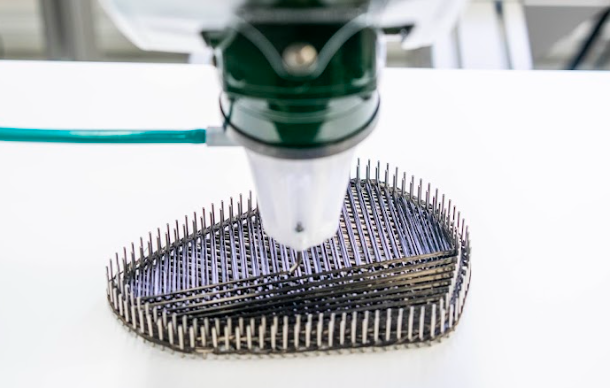
Holy Technologies is building that system: Holy OS and IFP (Infinite Fiber Placement), our proprietary automation technology. These two elements are inseparable: software intelligence requires hardware designed for autonomous control. Together they enable production that adapts to changing conditions without manual intervention. Let us now dive into how Holy OS transforms composite manufacturing from a slow, manually-coordinated process into autonomous production.
Read this article to learn more about how these systems work together, or this article for a deep dive on IFP's capabilities. For the remainder of this article we will focus on Holy OS.
Autonomous composite manufacturing requires hierarchical architecture at four distinct layers (Figure 2). Each builds on the next, with intelligence and decision-making authority increasing as you move up the stack. Holy OS is at the top layer and acts as the operating system, orchestrating the entire system and enabling autonomous operation.
.jpg)
This foundational layer consists of the physical manufacturing assets that execute production operations, such as production robots, curing ovens and injection machines. Each operates as a software-defined subsystem: reconfigurable rather than hard-coded, connected through unified data models, and capable of adaptive execution. Every machine becomes a connected node that feeds data upward and receives coordinated instructions from above. This creates the clean, real-time data flow that autonomy requires.
Composites demand that structural properties of the component and manufacturing process be reasoned about together. PATHWAY is our proprietary software that does exactly that, turning design requirements into precise, executable manufacturing processes. The integrated relationship between composite part geometry and manufacturing process is too complex for generic CAM software to handle, making PATHWAY the foundational intelligence layer that autonomous composite production depends on.
PATHWAY takes a part design and determines:
This layer manages production workflow and business operations. Production tracking software monitors work orders, manages shop floor scheduling, and follows every part through every stage of manufacturing. Inventory and supply chain management handles raw material stock, supplier coordination, and consumption forecasting. Quality management systems log inspection results, track defect patterns, and manage compliance reporting. Business planning tools translate customer orders into resource requirements, manage delivery commitments, and handle financial planning.
The critical limitation is that these systems cannot coordinate with each other in real-time. Each knows its own domain, but when conditions change (a machine breaks down, material arrives late, a quality issue emerges) they wait for human intervention to reconcile and decide how to proceed. This is where Layer 4 becomes essential.
This is the factory operating system: the command center managing the entire manufacturing lifecycle from customer order to delivery. Layers 1-3 provide capabilities (machines can execute, data can flow, processes can be planned, schedules can be created), but they cannot coordinate autonomously when something unexpected happens. Holy OS provides the coordination intelligence that makes the entire stack work together, in real-time, without human intervention.
Holy OS works as a network of specialized AI agents and learns from every part it builds, detecting patterns, refining parameters, and improving outcomes over time. These agents perceive conditions across all four layers, make decisions based on composite-specific constraints, and adapt autonomously.
What Holy OS orchestrates:
Consider a manufacturer of handheld industrial tools (power drills, torque wrenches, inspection devices) facing a familiar dilemma. Their metal components are mechanically robust and cost-efficient at volume. But they are heavy, and weight directly affects operator fatigue, productivity, and product appeal. The material to solve this has always existed. The production economics have not. Holy OS changes that calculation.
Weeks 1-10: Rapid Prototyping
PATHWAY (Layer 2) analyzes the part geometry and performance requirements, determines load-optimized fiber orientations, generates robotic toolpaths, and calculates cost per part based on actual production constraints. The software-defined production hardware (Layer 1) executes those instructions directly and feeds real-time sensor data back for continuous refinement. Feedback loops that traditionally take months compress into weeks.
Weeks 11 onwards: Production Preparation and Scale
Design approved. Holy OS (Layer 4) translates the validated design into a production plan, coordinating tracking, inventory, and supply chain systems (Layer 3) autonomously. As the customer scales from initial stock to full series production, coordination agents redistribute operations without manual escalation and quality agents adjust process parameters before deviations produce defective parts. Holy OS adjusts supply dynamically, making local production economically viable and eliminating offshore dependency.
What this delivers:
This is one example of a metal-to-composites transition. But wherever manufacturers need a better, lighter product, faster, and at the economics their production volumes demand, the system delivers.
This is why Holy Technologies built Holy OS: the factory operating system purpose-built for composites. Holy OS coordinates production across all layers, eliminating manual intervention, adapting to changing conditions in real time, and scaling without proportionally increasing labor. This makes composites competitive. Development cycles compress from months to weeks. Production scales efficiently to higher volumes. Delivery timelines become predictable. Manufacturers can compete on speed, cost, and scale. Software intelligence will define the next era of composite manufacturing.
Get in touch to learn more about our technology or to book a free component assessment with us.
.svg)

.jpeg)
.jpeg)