A Deep-Dive Into IFP-Components →
Hier lesen

.jpeg)
The global industrial hand tool market is valued at over $38,4 billion (IndexBox, 2025). Most professional hand tools are dominantly made of steel and can weigh 10+ kg. Many of these tools are used overhead, repeatedly, across a full shift. That weight has a cost.
Work-related musculoskeletal disorders (MSD) are the leading occupational health burden in Europe, its costs reaching up to 2% of the GDP. Plant and machine operators are among the highest-risk groups, driven by repeated hand movements and sustained overhead loads. In Germany alone, the condition generates an estimated EUR 17.2 billion in annual production loss (EU-OSHA, 2019).

Industrial tool manufacturers are aware of this. But for them, this is not only a health issue. It is a product limitation. The inability to significantly reduce weight without compromising strength has constrained tool design for decades. The challenge has been clear. How can weight be reduced without sacrificing the mechanical robustness of steel that professional users depend on? Today that challenge has a practical answer. Holy Technologies enables industrial tool manufacturers to replace load-bearing steel components with continuous carbon fiber structures, bringing tools to market that are up to 70% lighter while maintaining performance. This article explains how.
Steel is the dominant material choice for industrial tools for clear reasons. It is strong, predictable, affordable, and manufacturable at volume. For solid, load-bearing tools that absorb bending, impact, compression, and shear forces across years of daily professional use, no other material has offered a comparable combination of mechanical performance and economical manufacturability. But steel is heavy.
An average bolt cutter in the 600 to 900 mm range weighs between 3 and 4 kg. Hydraulic crimping tools weigh on average 6 to 7 kg and industrial clamping systems can exceed 10 kg. ISO 11228-1, the international ergonomics standard on manual handling, sets 3 kg as the threshold at which manually handled objects require a formal risk assessment. Most industrial tools exceed that threshold significantly.
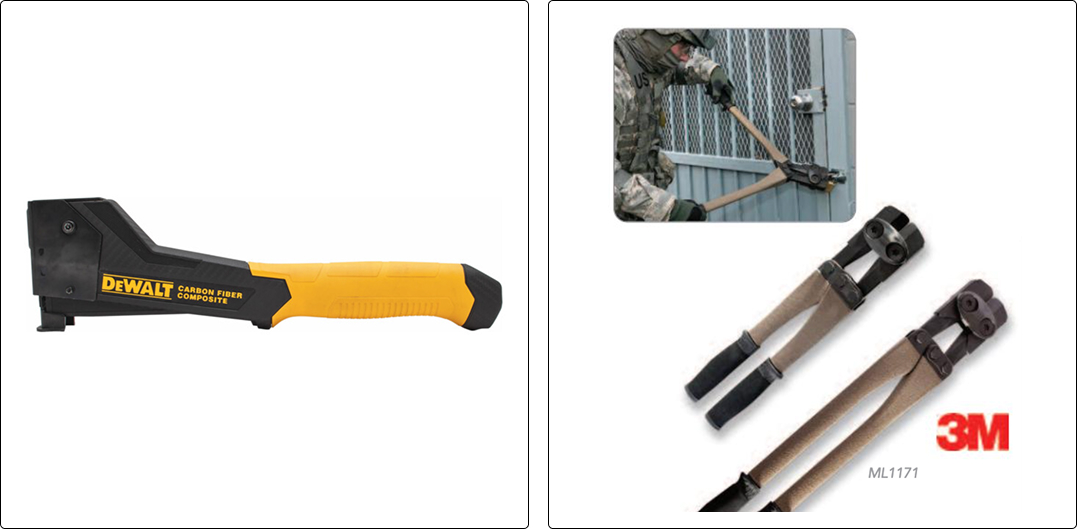
For operators using heavy tools repeatedly across a full shift, weight becomes a limiting factor for usability and efficiency. For manufacturers, this creates a growing gap between what their products deliver and what the market increasingly expects. The search for a lighter alternative has been underway for decades. Carbon fiber has always been a candidate. It can deliver comparable strength at a fraction of the weight, and first attempts have been made. DeWALT introduced a carbon fiber hammer tacker. 3M developed carbon fiber bolt cutters for military use. But adoption has remained limited. The limitation is not carbon fiber. It is how it is manufactured.
The mechanical performance of carbon fiber depends on the alignment of the fibers with the forces they carry. The dominant process for carbon fiber parts is manual prepreg layup, where sheets of carbon fiber fabric are cut, stacked by hand, and cured under heat and pressure.
This process works for thin-walled shells and simple geometries. It does not translate well to thick, solid, load-bearing components such as lever arms, clamp frames, or crimper bodies, which account for most of a tool’s weight. To build such parts, prepreg fabric must be cut to shape and manually stacked, introducing structural weak points along the fiber cuts, buckling, void content, and inconsistent alignment between the layers. Under sustained loads, these imperfections become structural risks. At the same time, the process remains labor-intensive, slow, and costly.
As a result, carbon fiber has not been able to replace structural steel components at industrial scale. The weight savings achieved in non-structural parts are not sufficient to justify the cost. The components that matter most have remained out of reach. Replacing these parts requires a process that can build material precisely around the load, maintain continuous fiber alignment, and operate at the speed and cost required for industrial production. That process now exists.
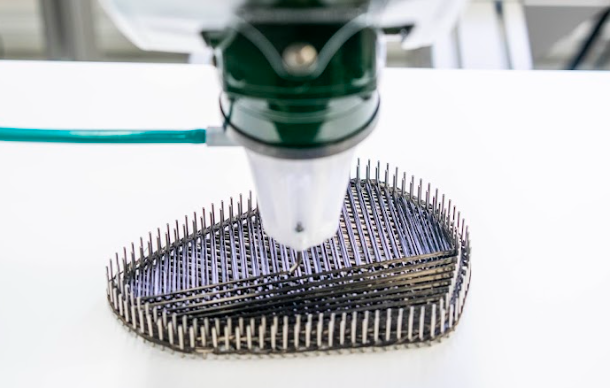
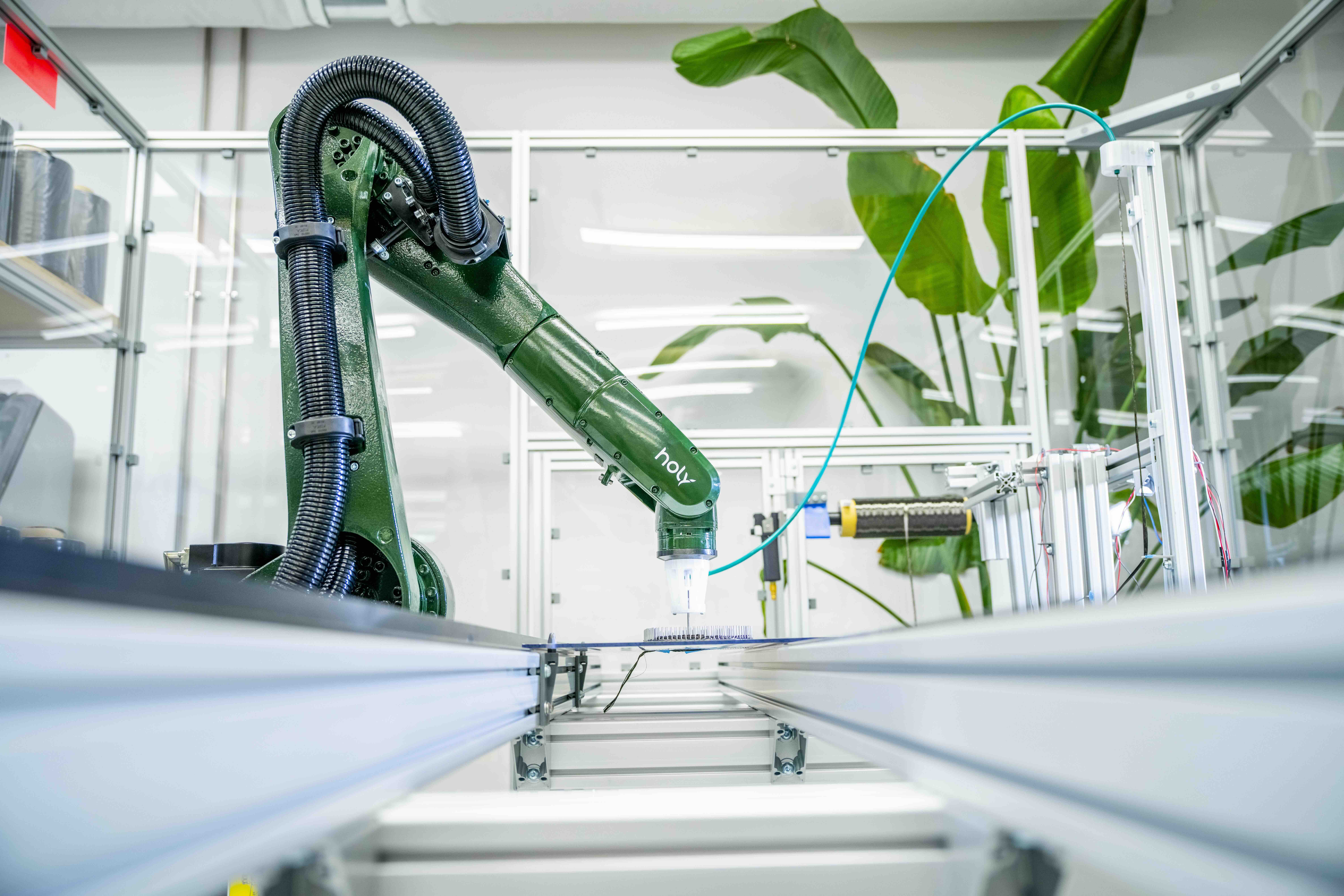
Infinite Fiber Placement (IFP) is a patented robotic manufacturing technology developed by Holy Technologies. It builds components by placing continuous carbon fibers along paths that are optimized for the specific load case of the part. Instead of cutting and stacking fabric, fibers are placed exactly where they are needed to carry load. This preserves structural integrity and enables consistent, repeatable performance. This includes components under compressive press loads, which have historically been considered the hardest force case for carbon fiber to handle in structural tool applications.
The process runs in three steps.
.jpg)
Read our full article on how IFP works here.
This approach enables the production of thick, load-bearing geometries with consistent fiber alignment and industrial scalability. For the first time, structural tool components can be produced in carbon fiber at the volumes and reliability required for series production. Holy Technologies has already validated this in practice, replacing load-bearing steel components with IFP carbon fiber parts achieving up to 70% weight reduction without loss of load-bearing performance.
The most relevant applications for IFP in industrial tools are components that dominate total weight and carry primary loads. These include lever arms in cutting and pressing tools, clamping arms and frames, torque wrench arms, hydraulic crimping structures, and large-format plier bodies. These components represent a significant share of overall tool mass and therefore offer the highest potential for meaningful weight reduction. All applications fit within IFP’s technical envelope, supporting part sizes from 100 x 100 mm to 800 x 800 mm, wall thicknesses from 1 to 40 mm, and flat or single-curved geometries.
.png)

More on IFP-components and their specifications here.
For European tool manufacturers, the shift toward lighter tools is not only about ergonomics. It is about maintaining a competitive position in a market where cost competition is increasingly dominated by China. China accounts for roughly 67% of global hand tool market share and continues to expand its position. European manufacturers cannot compete on cost at scale. Their advantage lies in quality, engineering, and innovation.
German tools, for example, command a significant price premium in global markets. That premium requires continuous justification through measurable product improvements. Weight is one of the few product characteristics that is immediately visible to the end user and directly influences perceived quality and usability. Tools that are significantly lighter without compromising performance offer a clear and defensible advantage.
Manufacturers who can deliver that advantage gain differentiation, strengthen their premium positioning, and create products that are harder to substitute. The transition from steel to carbon fiber in structural components has long been discussed. What has been missing is a manufacturing process that makes it viable at scale.
That condition has now changed. Manufacturers who move early can define product standards in their category. Those who delay risk competing on incremental improvements while others introduce fundamentally better solutions.
The highest impact comes from replacing the heaviest load-bearing components in a tool. Send us a component and we will assess its weight reduction potential and manufacturing feasibility.
.svg)

.png)